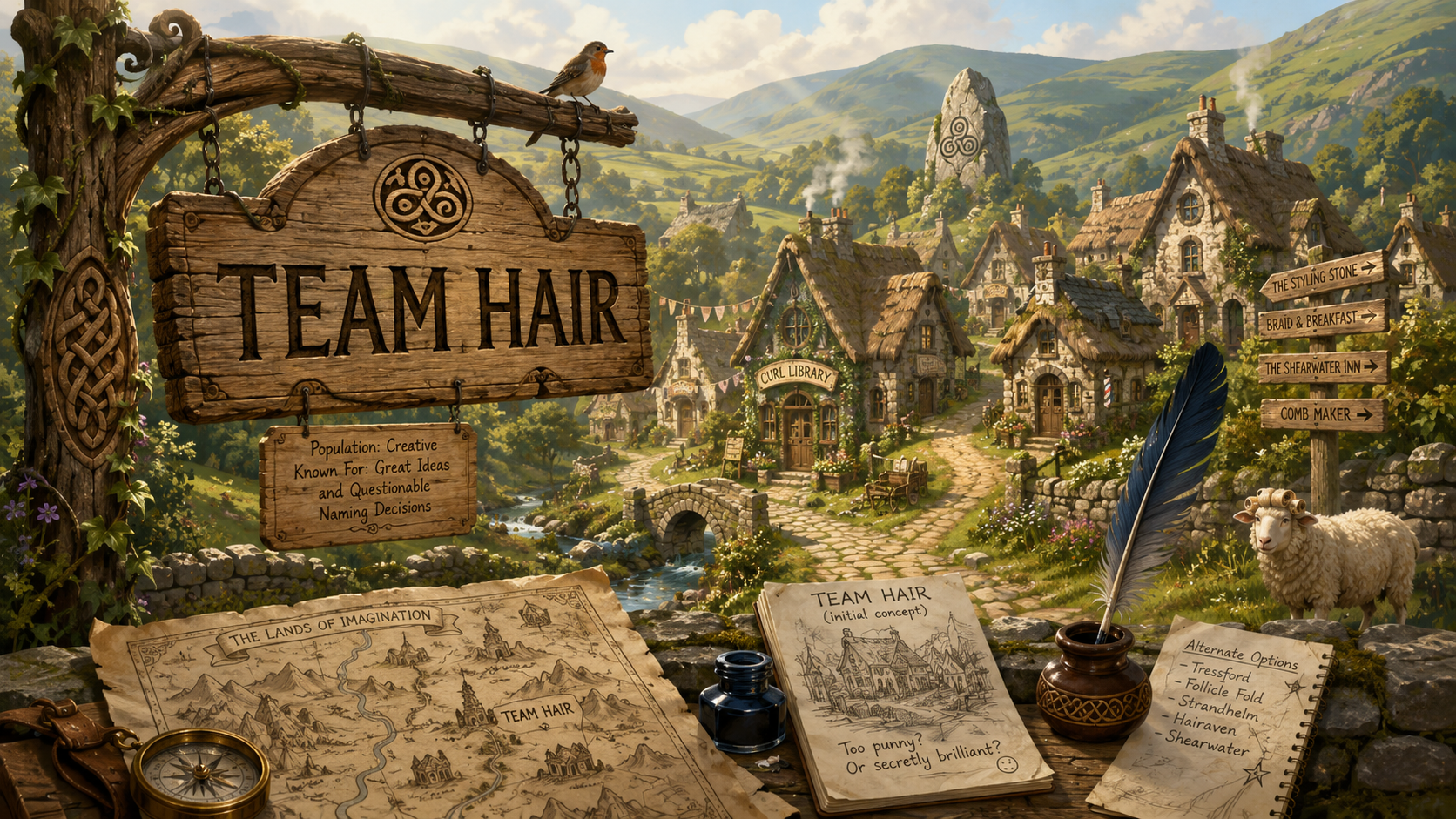
Naming Places in Tír na nÓg
(Or: How I Nearly Created the Village of Team Hair)
September 2026 <> From the Vale

There is something deeply unfair about naming fictional places.
When you are reading fantasy, a good place name simply exists. Rivendell is Rivendell. Winterfell is Winterfell. You encounter the name, accept that people have apparently been calling this patch of earth that for hundreds or thousands of years, and move on with your life.
When you are writing fantasy, however, somebody has to actually invent the damn thing.
And apparently that somebody is me.
When I started building Tír na nÓg for The Morrigan Cycle, I knew I didn’t want the map covered in names that sounded as though I’d generated them by throwing consonants into a bowl. I wanted the places to feel as though they belonged there—as though they had histories that existed before Bran ever arrived and would continue existing whether she wandered through them or not.
Sometimes that means drawing from Gaelic language. Sometimes it means borrowing from Celtic mythology. Sometimes it means starting with one of those things, wandering off into a linguistic forest, and eventually emerging with something that is no longer technically either one but feels right for the place.
This is probably a good point to confess something.
I have no idea how to pronounce half of these names.
Possibly more than half.
I know what inspired them. I know what they are supposed to evoke. I can explain why I chose them. But if you are reading Awaken the Raven and encounter a place name containing a suspicious collection of vowels and consonants and think, How in the hell am I supposed to say that?
Excellent question.
I am probably wondering the same thing.
Fortunately, they look like they would sound really cool.
Names Need to Feel Older Than the Story
Tír na nÓg isn’t a world Bran created by arriving in it. She is walking into a civilization with its own politics, grudges, roads, legends, ruins, sacred places, and people who have been irritating one another for centuries.
The names need to carry some of that weight.
Raven’s Head works because the place is tied visually and thematically to ravens. Fhithich Woods takes that connection further through Gaelic roots. Paedar’s Leap sounds as though there is probably a story behind it—and there is absolutely the implication that at some point some poor man named Paedar made a questionable decision near a very large drop.
Then there are names such as the Vale of Veyrath and the Morvarens that aren’t intended as direct Gaelic translations at all. They simply needed to sound as though they belonged beside the older names rather than having wandered in from another fantasy world.
That balance matters to me.
I don’t want every name to require a linguistic footnote. Real places don’t work that way either. Languages evolve. People migrate. Names get shortened, mangled, borrowed, translated, misheard, and stubbornly preserved long after everyone has forgotten what they originally meant.
Which gives me considerable creative freedom.
Convenient, isn’t it?
Sometimes I Know Exactly What I Want a Name to Mean
One of my favorites came from wanting a river whose name essentially meant River of Tears.
That eventually became Abhainndeor.
It isn’t intended as a scholarly declaration that this is the one correct historical Gaelic construction that should be submitted for peer review. It grew out of Gaelic language roots and then became part of the language and naming tradition of this version of Tír na nÓg.
That distinction is important to how I’m approaching the entire world.
The mythology underneath The Morrigan Cycle is real. The Celtic and Gaelic influences are real. But Tír na nÓg itself is my fictional world built from those roots. I want readers who know the mythology to recognize echoes without requiring the story to behave like a mythology textbook.
The names follow the same rule.
Sometimes the root is visible.
Sometimes it has wandered a considerable distance from home.
And sometimes I just stare at a map and think, Yes. That sounds like somewhere Fey would live.
And Then There Was Team Hair
This brings us to perhaps the greatest danger in fantasy cartography:
Accidentally naming a village something ridiculous.
At one point, I had a name rooted in Teamhair, the old Irish name associated with Tara.
Perfect.
Ancient connection. Mythological resonance. Gaelic roots. Exactly the sort of thing I wanted.
Then I looked at it.
Really looked at it.
Teamhair.
Team Hair.
I had created Team Hair.
Once you see that, there is no going back.
I tried.
I stared at it on the map and attempted to recover the dignity of ancient Ireland. I reminded myself that this was a legitimate historical name with centuries of significance behind it.
My brain responded:
TEAM HAIR.
And suddenly I was no longer imagining an ancient Fey settlement. I was imagining some sort of aggressively enthusiastic salon competition.
Welcome to Team Hair, traveler. Choose your allegiance: curls or braids.
Absolutely not.
So the name became Temhair.
Is that an act of linguistic cowardice?
Perhaps.
Do I regret it?
Not even slightly.
There are limits to how much authenticity I am willing to preserve when my brain insists on turning an ancient place name into a competitive hairstyling organization.
The Map Makes Everything Worse
There is also a peculiar danger in actually making the map.
Names that look wonderful in a list behave very differently once you place them beside mountains, rivers, forests, towns, and all the other names you’ve already chosen.
Suddenly you discover three locations begin with the same letter.
Or two names rhyme.
Or a perfectly lovely seven-syllable name needs to fit beside a mountain range where there is approximately enough room to write BOB.
Or, apparently, you discover Team Hair.
So there has been a lot of staring at the map, changing something, staring some more, changing it back, deciding the first version was better, moving the label six pixels, deciding the entire civilization probably needs renaming, and eventually remembering that I am supposedly doing this for fun.
Mostly, it actually is fun.
There is something wonderfully satisfying about the moment when a name finally clicks into place. The unnamed collection of trees becomes Fhithich Woods. A stretch of river becomes Abhainndeor. A mountain range becomes the Morvarens. A valley becomes the Vale of Veyrath.
Suddenly they stop feeling like features I drew on a map.
They become places.
So How Are You Supposed to Pronounce Them?
However you manage.
Seriously.
There are names for which I have a general pronunciation in my head. There are others where I have looked at the Gaelic source, listened to pronunciations, tried it myself, reconsidered several of my life choices, and quietly decided that readers can work it out on their own…. because I am stumped.
If you speak Gaelic and know that I am committing crimes against your vowels, I apologize in advance.
I mean well.
And if you don’t speak Gaelic?
Welcome. Pull up a chair.
We can confidently mispronounce them together.
Because ultimately, what matters most to me is that when you encounter one of these names, it feels as though it belongs to Tír na nÓg. I want it to suggest that somebody named that river long before Bran saw it, that generations have crossed that mountain pass, and that every village has stories Bran hasn’t heard yet.
The world should feel older than the book.
Even if occasionally one of those ancient, mysterious places almost ends up being called Team Hair.